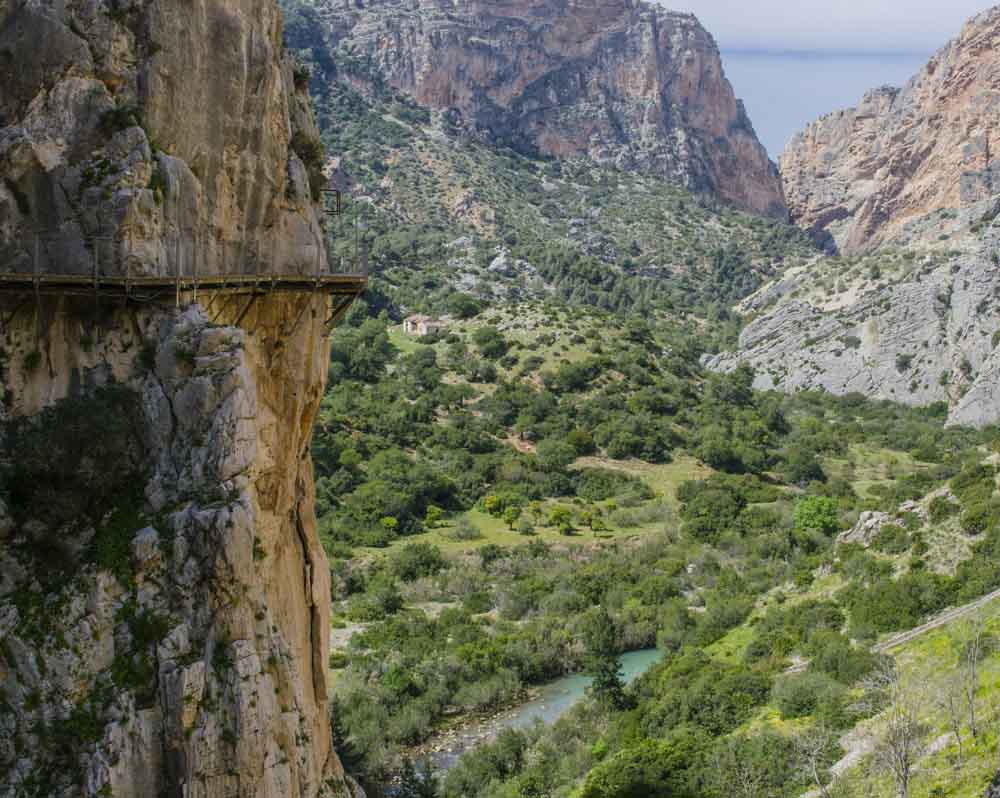
EL CAMINO DEL REY El Chorro 1991
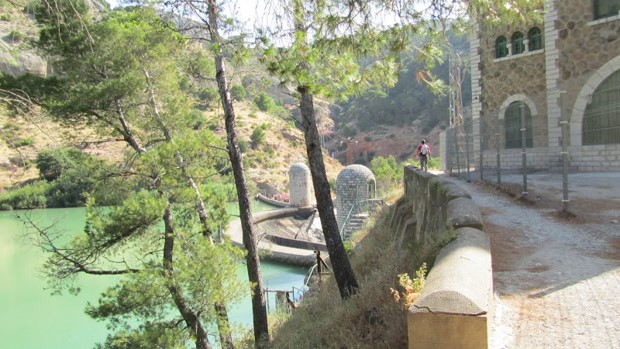
El Camino del Rey begins beside a small castle of pale brown sandstone, by a small lake surrounded by green pine forest. This is the Guadalhorce River, which, on its long journey from the border with Granada down to the Mediterranean, has here been caught behind a dam beside the power station.
A narrow footpath leads past the artificial waterfall below the dam, and we follow it to the right, curving around the hollow of the valley, with the now released, roaring river below us. Ahead, we see the mountain open into a narrow cleft and, at the very entrance, a rushing waterfall twenty or thirty metres beneath us.
The first thing we come across is an old enamelled metal sign, above what was once some kind of wrought-iron gate. “No Entry,” the sign says. That is where we go in.
Ahead of us stretches a narrow, man-made ledge, perched on one side of the gorge as it twists into the mountain, cut into the porous limestone, full of holes and crevices. We watch the balcony cling to the ravine like a long piece of string, following the winding rock face.
Concrete posts line the half-metre-wide walkway, with a sturdy railing of iron pipe running between them. It feels relatively safe. The gorge is quite narrow here, perhaps ten or fifteen metres across, and the landscape before us is strange and a little frightening. The sky lies like a thin, pale blue ribbon a hundred metres above our heads, where the rock walls end. The thundering river rushes down below, and we can look into the abyss—fifty, sixty, seventy metres—where pigeons flap about and perch everywhere on small ledges.
We are only at the beginning of our journey when suddenly we see a long hole in the walkway ahead of us. There is plenty of room to get past, but we raise our eyebrows all the same. Shortly afterwards, the railing itself is missing between two posts, and then we feel a slight flutter in our stomachs as we instinctively edge a little closer to the rock wall.
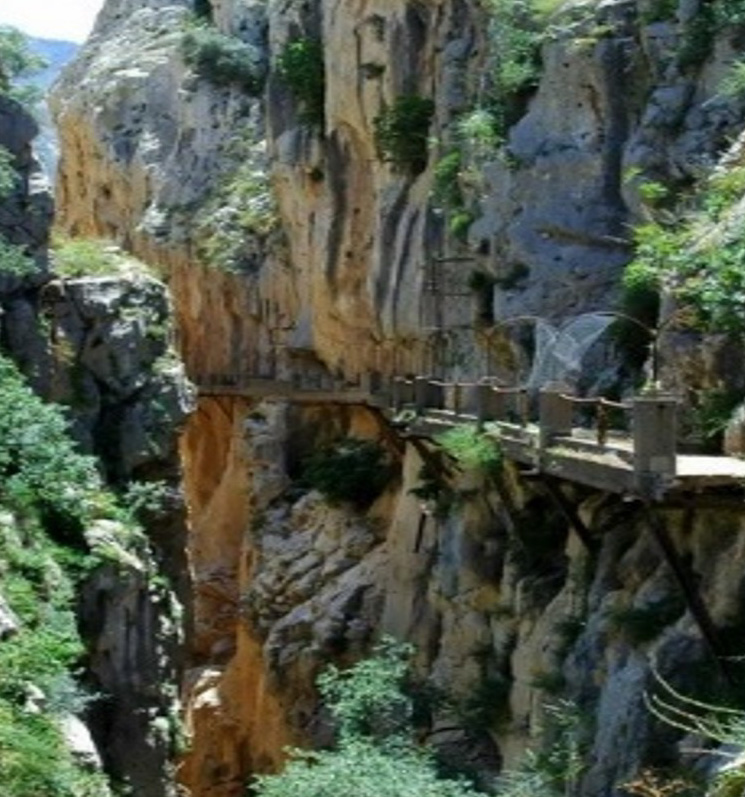
After a kilometre or so of winding progress, the cleft in the mountain widens, and at its bottom the river has paused for a moment to form a small pool. Above us, swallows hurl themselves through the air like arrowheads in a death-defying display between the sides of the ravine. We duck beneath an overhang and see the path stretching ahead for several hundred metres.
Here we descend a few flights of steps and come upon an open channel emerging from a black hole in the rock. Looking back and upwards, we can see how the ledge itself is attached to the mountainside by iron supports, on which lengthwise beams have been laid. Between them, a shallow brick arch has been built, and the cement poured on top. That is all.
The channel to our right is a couple of metres wide and several metres deep, with water flowing quietly along the bottom. We follow it for a while, walking along the very outer edge, with the torrent directly below us to the left. There is no railing at all, and in one place, a few planks cover a section where the cement has fallen away. They rock alarmingly beneath our feet. Elsewhere, a piece of reinforcing bar sticks up, threatening to trip us just where the outer side of the walkway has collapsed, and only the rusty iron beam remains. By now, we are beginning to wonder. Ahead, we see the path clinging on, entirely or partly without a railing. This is where the Sunday strollers give up and turn back, patting one another on the back, assuring themselves that what a pleasant and exciting weekend they have had.
As we lower our heads through yet another low passage, we see that the cement has pulled away from the rock face for a considerable distance. A crack an inch wide, through which we can look straight down. Now, not only is the railing missing, but several of the posts are gone as well. A slab of the platform itself hangs at an alarming downward angle, but a remnant of railing and a few decimetres of intact walkway are enough to get us past.
We are given a brief, deceptive respite, where for a few metres the path crosses dry land, with a few pine trees, grass and broad leaves to calm our nerves. But soon we are back on the projecting rock face, and the ledge feels its way out into the air, more fragile than ever. Nothing remains but a broken slab of cement. No railings, no posts. At a bend, a rusty beam juts straight out into empty space. Here, the drop is sheer, seventy, eighty metres. The river boils and gurgles far below, and the walkway is forty centimetres wide as, with a growing sense of unease in our chests, we make our way around the next bend, turned towards the cliff, gripping it with our hands.
Cracks in the concrete, a hollow sound beneath our feet, and suddenly a couple of metres of the path are missing. It has simply collapsed. We have to balance above the abyss on the rusty outer beam, our hands against the rock. Once safely across, we sit down for a while and wipe the sweat from our foreheads.
Then we see ahead that we have reached the wooded valley separating the first and second sections of El Camino del Rey. The glittering river winds along the valley floor, forming a chain of small pools surrounded by flowering oleander. Birds sing in the trees as we walk beneath their shade, the ground glows with yellow flowers, and we hear the distant roar of running water.
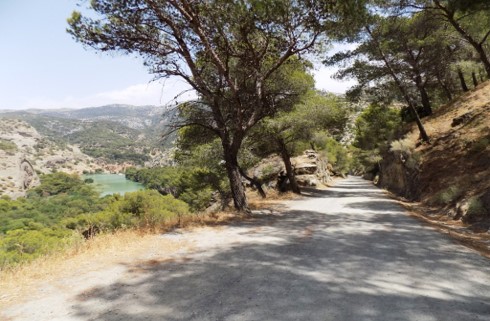
We pass an old dam, now dry, but still with a beautiful iron wheel that was once used to regulate the water level. Beside it stands a lush, dark green carob tree. In a glittering stream grow clumps of tall, sturdy esparto grass, a metre high. Through the branches of the pine trees, a kilometre away, we see the rock walls rise once more, drawing closer until they meet at the next chasm and the second part of El Camino.
This is where it begins.
The previous stretch has been no more than a pale foretaste, a cheap rehearsal for what is to come. First, we have to climb a couple of metres to reach the ledge itself. Here, there are no railings, no posts, no edging. Here, there is nothing but an encounter with yourself. The cracks grow larger. A gap a couple of metres wide, crossed by balancing along a beam. Another of the same size. And more than a hundred metres straight down.
Here, the path clings to the rock like a fragile mistake, suspended between heaven and earth. The cliff face itself is two hundred metres high, and halfway up, this frail ledge feels its way forward. It climbs in a gentle curve towards the mouth of the gorge itself. Here it is worse than in the narrow passages of the previous section, because there is nothing on the other side to fix your eyes on; we have not yet entered the ravine. There is nothing to do but turn your head sideways and stare into the rock while your feet shuffle along. Sometimes the wall juts out, and you have to lean over the precipice, edging around a corner with less than thirty centimetres beneath your feet. It is then that you wish you were wearing something other than boots from Valverde.
Don’t look down. Don’t look down.
We make it around and into the gorge itself, which here is broader and more immense than the first. The mountainside opposite is enormous. Vast and sheer, it stands before us, and it is impossible not to feel it, to see it, and to sense the pull rising from the depths like a powerful magnet.
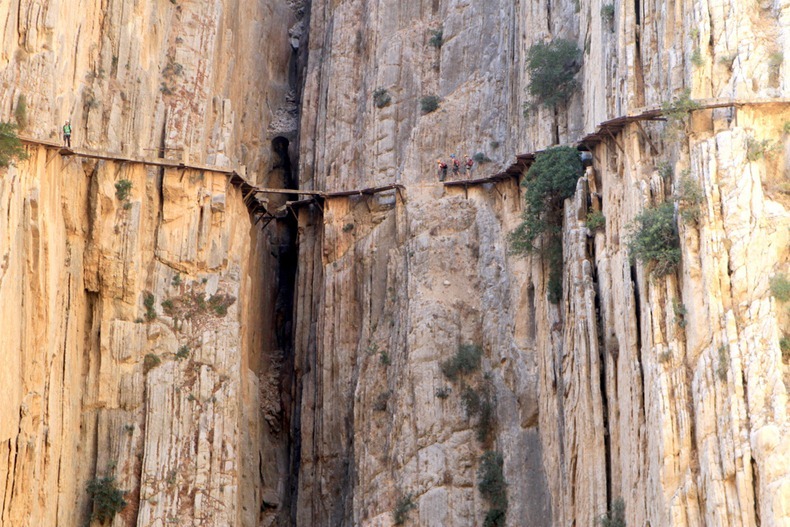
Cracks, holes, hideously frightening corners where the platform simply disappears into nothing. My head feels ready to burst, vertigo twists in my stomach, and my legs want only to give way. Yield to the magnet in the depths for a millisecond, and you will fly out into space as a film played backwards. There is nothing to do but think your way forward in blind panic, deceive yourself, and think of the goal. The one place you must not be is precisely where you are. It has to end. My fingers search for cracks and hollows.
Suddenly, around a projecting section where the path disappears into a fissure and emerges again ahead of us, a girl is clinging to the sheer wall thirty metres above. Her body turned towards the rock, she is plastered there like an anatomical study by Leonardo, arms and legs splayed in every direction. On the ledge stands a young man, holding a rope with studied nonchalance. Somewhat shaken by this encounter, I continue past them and must admit, to my credit, that I chose the outer edge, though I hesitated for a moment first.
Shortly afterwards, we reach a bridge, which is really the water channel itself. Here it emerges from the mountain, leaps across to the other side and disappears into the rock again. But that’s all right. It is a solid, heavy pipe, with an iron railing on either side to cling to. We cross over its rounded top and feel almost safe. There is not far to go now. We can see the end of the ravine, where the landscape opens out and, a few kilometres away, the railway station at El Chorro.
But then it comes.
Just as we step off the bridge into safety and, on shaking legs, prepare to pass the final outcrop, the platform is gone. A vast hole simply gapes before us. It is more than five metres to the other side, well over a hundred metres straight down, and I am not going back. The inner beam, close to the cliff, has disappeared. The outer one, here where the rock curves into a hollow, hangs more than a metre out in empty space and is barely five centimetres wide. Some kind soul has strung up a slack cable to hold on to.
The only way across is in a crouch. The cable runs close to the wall, the beam far out from it. Bent double and leaning forward, I shuffle one foot out onto the beam, then the other. Now, of all times, I must not look down. But what else can you do in this position? The cable bobs up and down in my hands. A piece of wire wound around the beam makes my foot slip.
My palms grow sweaty, my knees buckle, my stomach feels as if it has been thrown into a falling lift. I could freeze here for weeks and be fed through a tube by understanding people. Not even a Sherpa rescue party sent all the way from Nepal could make me let go.
And then a sweet little creature of about sixteen appears on the other side, wearing rainbow-coloured nylon gaiters. She smiles at me, and I wonder whether what I am seeing is real. I swallow the terror in my throat, force a Frankenstein smile onto my dry lips and shuffle my feet onwards until I reach the gingerbread-thin cement platform and salvation.
“Hola,” she says cheerfully, and with one hand running along the cable, skips across the beam to the other side in a few light steps.
And suddenly I see them everywhere.
They cling to the rock walls like swarms of flies. Some of the country’s finest rock formations for vertical climbing are here, and people come from every direction to practise their favourite sport.
I look up and down, not quite understanding what I am seeing. Kids of sixteen or seventeen, girls as well as boys, perched hundreds of metres up sheer rock walls. They move like spiders, fingers and toes feeling for cracks in the rock.
As I walk along the railway track towards El Chorro in my boots, black jeans and striped flannel shirt, my camera over my shoulder, I watch them giggling and bouncing along in their trainers. In groups they are heading home after a weekend in the mountains, happy and content, with their colourful rucksacks, ropes and climbing shoes.