Hjos de E. Morales
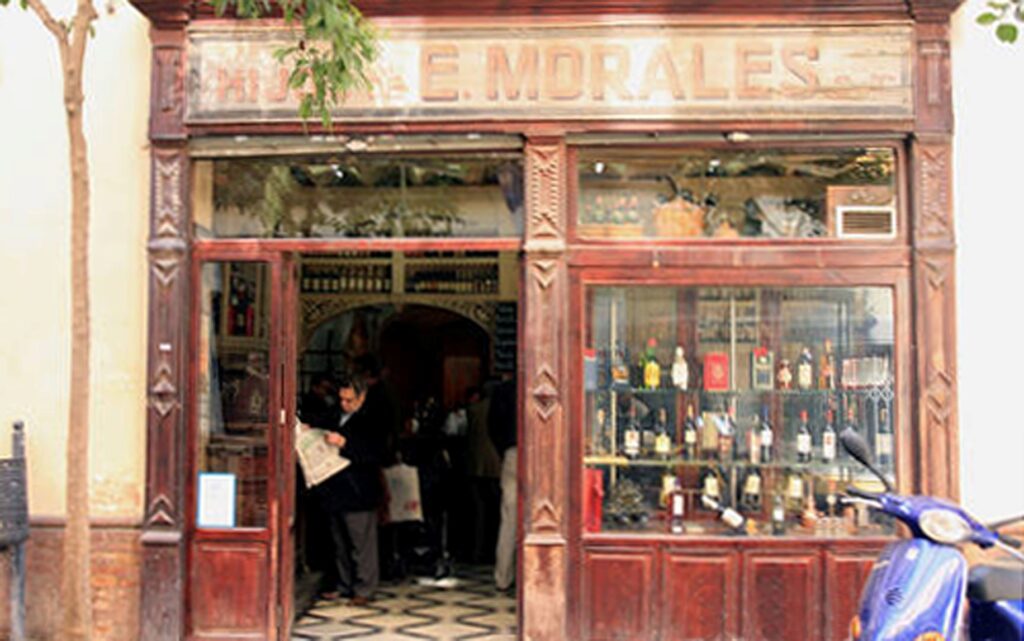
Seville, 1991.
A few steps from the Cathedral, an old bodega seems to have escaped the movement of time. Among wine barrels, sawdust, faded walls, and the people who pass through its doors, a small world continues according to its own rhythm.
It is located just a few steps from the Cathedral of Seville. A block below García de Vinuesa, in the direction of the river. It is the corner house, a slightly rounded corner. Dark brown façade in painted wood, a little worn, to say the least. Above, on a light grey background, you can read “Hijos de E. Morales S. en C.”, painted in red with a black shadow many years ago. Two yellowed pieces of cardboard, each with the number one set next to each other, with rusty thumbtacks.
Next to the door is a shop window with a couple of dusty glass shelves. A collection of cognacs, sherry and wine bottles, each with a clear price tag on it, even if the sun has long since faded away the price itself, gives us an idea of what is hidden in this room.
The inside is just as worn as the outside. The walls are yellow with age. It hasn’t been repainted in the last fifty years, if at all. Old Seville tiles from Triana cover the walls up to the shoulder. Cast iron pillars support the rafters.
Red, yellow and green plastic crates with beer and soft drinks in one corner and a worn mahogany bar counter opposite. One of the walls behind is clad with compartments in which the collection rests. Peppermint liqueur, Fino, Cherry liqueur, Ponche, Oloroso long life, Champagne, Rioja, Vinegar (formerly of our own production and based on egg yolk), Anise, Veterano and Etiqueta Negra. Barrels of Sherry. A bartender in a white apron with a chalk behind his ear.
A customer comes in but must wait a while. Don Antonio, the bartender with a slightly pockmarked face, serious with a welcoming expression, is engaged in a lively conversation with the cashier, who is perched on a chair in a niche. Bottles of Clavo de Olor Piña de Cazalla de la Sierra, wrapped in tissue paper, perched on a shelf.
A bullfighting advertisement from the excitement on the Sunday Fair of April-Nineteen Hundred and Eighty-Eight. Espartaco, Curro Romero, Rafael de Paula and more. Don Antonio assures us that everyone is still alive. Curro Romero has also taken several glasses here in the bodega, as well as Paquirri, who was killed by a bull, but that was before eighty-eight.
A man with a bald head, but thick dark hair combed back at the temples, is dressed in black trousers, a cream-colored blazer and a white striped nylon shirt. He wears a dark tie with a clip, grey moustaches and aviator glasses. Sipping his wine glass and discussing football together with an uninteresting type in a tomato-coloured shirt.
The mist from my beer glass draws dark, shiny rings in the reddish wooden surface of the bar. The floor is covered with light sawdust. A grey silk suit with well-pomaded hair lingers over a glass of wine before discreetly returning to his everyday life. Cobwebs between shelves. Black dusty fans have stopped for the season. A clock up on the wall stopped at ten to ten, forever.
To land as if in eternity, is to catch one’s breath for a while in this boiling, seething Seville, where you break up streets, divert rivers, tear down and build up. Relaying railways, pulling in motorways, renovating, polishing up and creating new companies. Amid all this madness lies the island of Cartuja with its “Tivoli for adults”, the world exhibition where the work goes on without a break, twenty-four hours a day.
Pigeons flap in the doorway, outside and inside. A bicycle trailer stops in the sunshine on the small alley. Steel-wire crates filled with unlabelled wine bottles are unloaded and carried in. The clink of glass against metal is strangely pleasant.
A man in his forties smokes a Havana cigar, wears an expensive but discreet grey shirt, a gold watch and a strong gold bracelet around his neck. He looks as if he were visiting the city from his finca on the outskirts, conversing with discreet but telling gestures, while having a glass of Fino. A young couple, tourists, drink beer in a jug and look around with wide eyes and low-key comments.
Eighty out of a hundred,” says the bartender, cashing the sum into a green cash register from the fifties. It faces the room, while the coin box itself goes out in the other direction, where the cashier is sitting. And it is the strangest creature I have seen in this city filled with the most marvellous personalities.
It is a gentleman in his eighties who slumps on an old office chair that has been raised in height for his now insignificant body. His wide, grey flannel trousers spill over the seat of the chair, and his hunched back is dressed in a dark blazer with a white handkerchief in his breast pocket. The white hair over the limp, pale, half-asleep face is covered in a black beret.
Yes, he looks as if he is asleep, and has been doing so for ages, but when a coin comes sliding through the air, flipped by Don Antonio, his hand is ready to receive it without being seen to move. His little eyes come to life; the coin is placed on the marble slab to the right. Small, neatly organised stacks of coins have been prepared while waiting for banknotes. The eyes close, the arms sink, and our friend returns to his transcendental state.
For one hundred and forty-two years, the bodega has remained unchanged here and has been passed down from the founder to his sons, who are now over eighty years old, and have guarded every peseta that has fallen into the coffin all their lives. Slowly but surely, the family has acquired almost the whole block, even though only the brothers, a daughter and their family live there. Right next door, you have warehouses from which wine is distributed to homes and to bars and restaurants in the city. Just give a call or leave a message in the bodega, and you get it delivered to your home.
Don Antonio proudly says that the venue has been visited by the mayor of New York, that they have been a scenario on film sets. Catherine Deneuve has been here, as well as dancer Antonio Gades and flamenco singer Chocolate. Now they even have their own caseta, their own tent, at the April fair, together with the Marquises Cabriola and Natilla.
At half past eight, the gates to the bodega itself, which is located just inside the bar, open. When we enter the Sanctuary, we are first greeted by a worn tin counter, a primitive bar for those who are waiting for a seat at the tables.
Tables and chairs are small, fine, foldable pieces of stick furniture that are placed along the walls of the room. Or not really directly at the walls, because along them stand tall, huge monsters. There are a dozen or so clay wine vats, constructed on site ninety years ago. They are over three meters high, one and a half in diameter, and each holds one thousand five hundred litres of wine from the family’s vineyards in Valdepenas. They are slightly reddish in colour, with fine cracks that ooze a little. A ladder of dark wood stands against one of them.
A naked light bulb shines under a vaulted ceiling, where the moisture damage and the falling plaster paint imaginative pictures. Over the irregular arch into the bar, there is a streetlamp that you wonder if it has been borrowed from the alley outside.
All the tables, which are placed next to the large wine vats, or tinajas as they are called, are quickly occupied, and the old bodega comes to life. Cigarette butts and crumpled napkins begin to cover the grey cement floor.
In the far corner of the room sits a group of white-haired gentlemen in grey jackets and ties. On the table, they have folded paper cones with fried octopus in golden yellow rings from the deep-frying fish shop across the alley. These are grasped with your fingers and brought to your mouth with a delicate gesture. They drink white wine while a photostat copy from ABC, the conservative daily newspaper, wanders around among the gentlemen and is quietly commented on.
A young couple holds hands and talks quietly with their heads close together. A couple of German businessmen, perhaps attracted by the World Fair, are discussing a project with great eagerness, marking their mutual positions with important facial expressions.
In the spaces between the tinajas are stacks of cartons, which have contained Havana cigars and sherry bottles. Behind a net, an old burnt-out engine for siphons. In one corner, a broom and a shovel used to mix cement. An empty beer barrel in tin and large green wine demijohns. Under each table a bucket for everyone who brings fried fish, and where leftovers and paper cones are shaved down.
A couple of young Englishmen in black T-shirts and black leather jackets, stubble and hiking boots are having a lively discussion. They laugh and wave their arms, order more wine. “Shut up! Shut up!” Both are eager to get the word out in all kindness.
In the other corner of the room, which you might call its rear part, there is like a narrow passage behind some huge wine barrels in darkened oak wood. A mixed group of young people have folded together a few tables covered in paper, fish scraps, beer glasses, wine glasses and Coca-Cola bottles. As always in this country, there is an intensity and liveliness, fish and paper go in the bucket, wine glasses are emptied, and all in all, the atmosphere is absolutely excellent.