
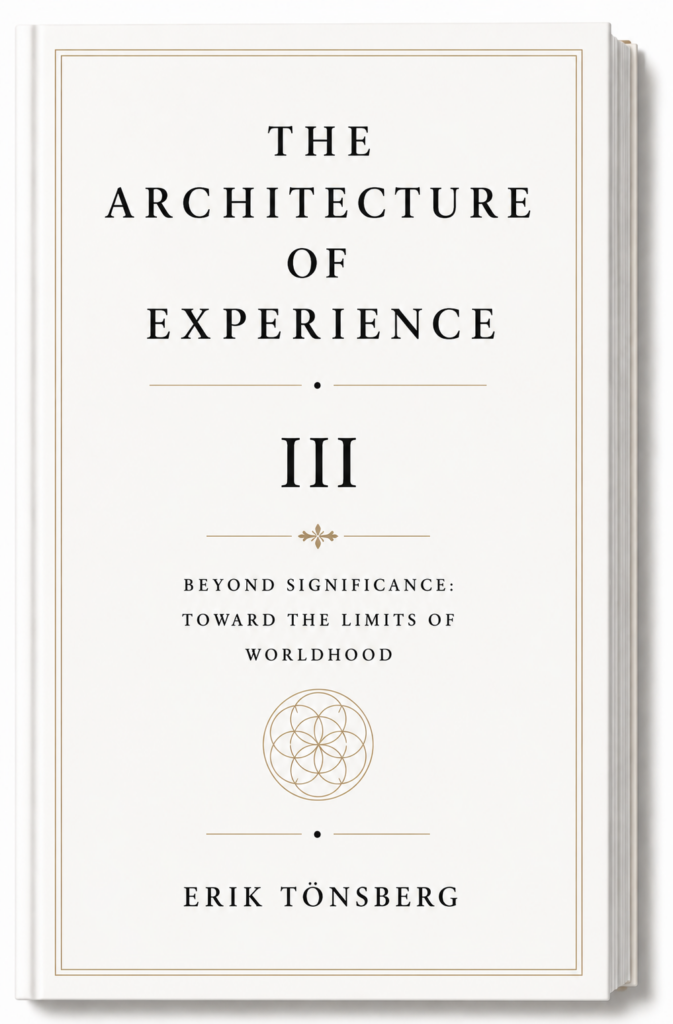
Available soon
We open our eyes, and there is a world.
Books I and II asked how that seemingly effortless reality becomes possible.
Book III takes the inquiry one step further.
What happens when the very structures that make our familiar world possible begin to change?
Across cultures and throughout history, people have described experiences in which the ordinary boundaries of self, time and space become radically altered—or seem to disappear altogether.
Such experiences occur in meditation, mystical states, psychedelic experience, near-death experiences and sometimes without any apparent cause.
They are often described as extraordinary.
But perhaps the most interesting thing about them is what they reveal about the ordinary.
If the self can disappear, how is it normally maintained? If time can cease to flow, what gives it its familiar direction? If the boundary between oneself and the world can dissolve, what creates that boundary in everyday experience?
Beyond Worldhood begins there.
Not by asking us to believe extraordinary claims, but by using extraordinary experience to question what we ordinarily take for granted.
Books I and II asked how a world becomes possible.
Book III asks what may be the most unsettling question of all:
Are the conditions that make our world seem so unquestionably real as fixed as we think?