BAMYAN
Bamyan, Afghanistan, 1977
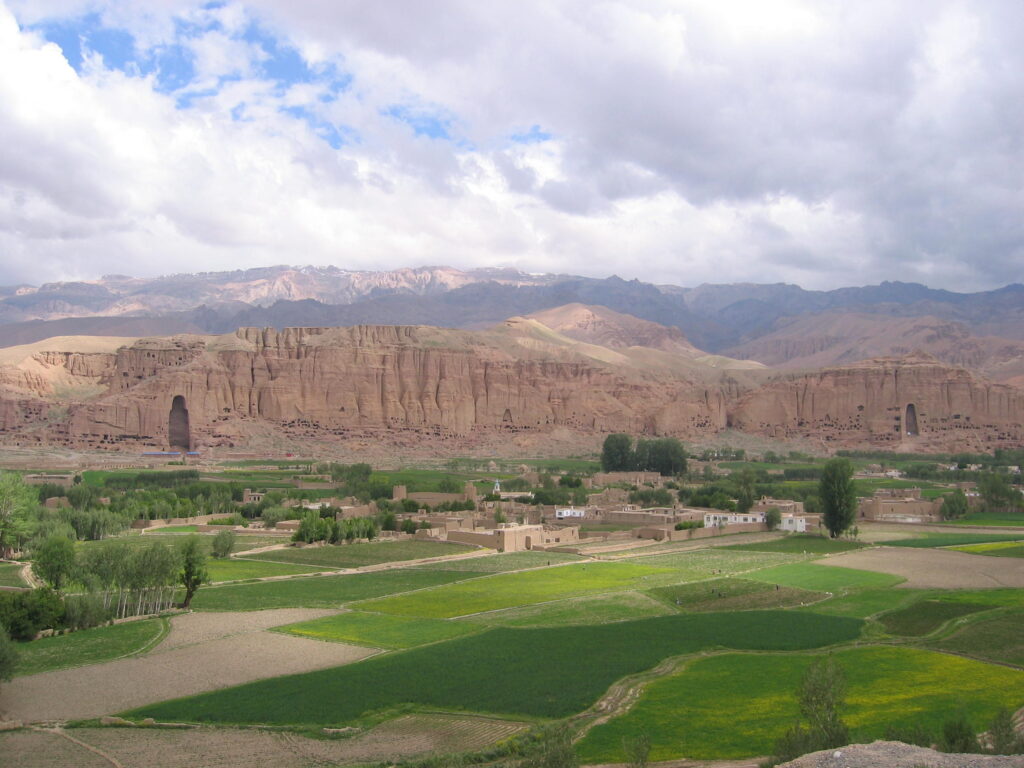
Shivering in the early morning cold, we sat in the hotel garden warming our frozen fingers against steaming glasses of tea while munching warm, freshly baked bread dripping with honey from the Pamirs. We were about to set off on the daily bus to the Bamyan Valley, in the northern part of central Afghanistan, with the Hindu Kush mountain range to the north and the Koh-i-Baba to the south.
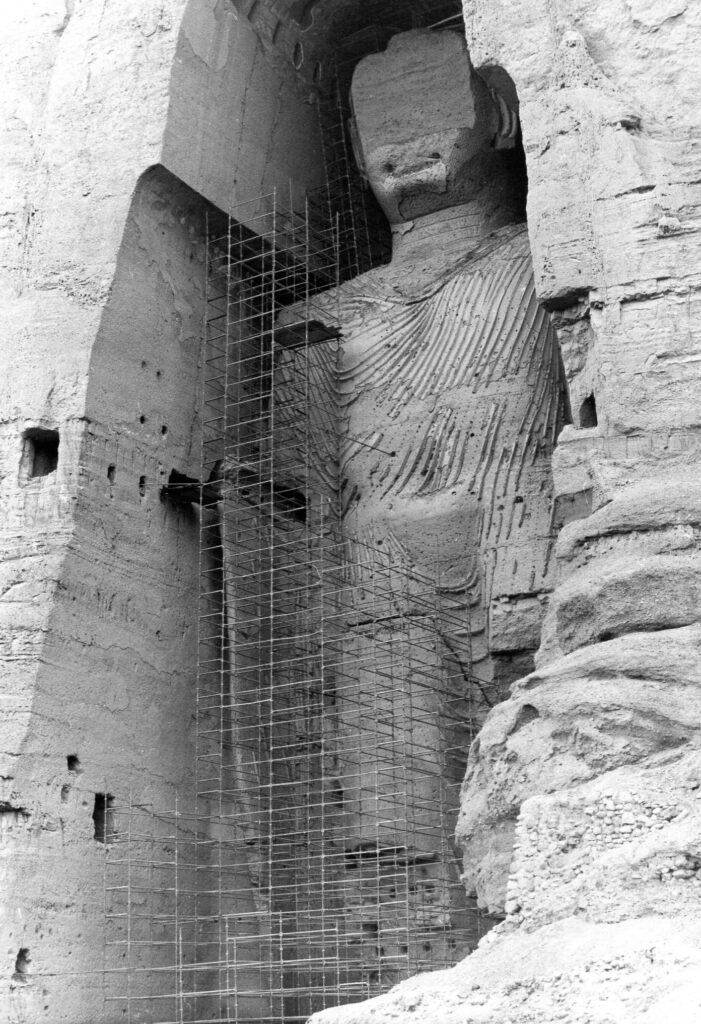
More than fifteen hundred years ago, the valley was inhabited by Buddhist monks and was an important centre of Buddhist power. Dwelling caves and assembly halls were carved into a sheer sandstone cliff; at either end of this several-kilometre stretch stood two gigantic figures of the Buddha. The larger was more than sixty metres high, and the other was not far behind. They were what we wanted to see, and they lay only a day’s journey from Kabul, the capital of Afghanistan, where Kersti and I found ourselves on this cold April morning.
At half past five, the little minibus stopped outside the gate, and we squeezed in among some twenty laughing, noisy Afghans in turbans and patched relief-aid coats.
Off we went northwards, up through the Kabul Valley on the fine asphalt road towards Mazar-i-Sharif, a gift from the Soviet state. The bus was relatively new and comfortable, and, fortunately, we were given seats at the very back, cosily wedged between a few robust farmers from the Bamyan Valley, where we could stretch our legs into the aisle. Bus interiors in Asia are certainly not built to European dimensions!
After an hour or so, we slow down, and the whine of rubber tyres on asphalt gives way to the shaking and bouncing of a dried-out cow track heading west. The sun rises higher in the sky, and it grows hotter with every passing hour. Dust forces its way in through the floor and cracks around the windows, and the Afghans, whose cheerful high spirits gradually give way to an increasingly strained silence, sit squinting against sun and dust, chewing the ends of their turbans for saliva. The road grows bumpier, the bus lurches more violently, and the heat increases, until someone accustomed to the steady sway of camels quietly and discreetly empties the contents of his stomach onto the bus floor. There is no question of saying anything or stopping for a minute to rest.
All this while we travel beside a roaring spring river, past small pale-brown villages of sun-dried mud, nestled among tender spring greenery and flowering cherry trees.
After eight hours of physical torture but visual splendour, the broad, bright valley opens before our eyes.
The bus stops in a cloud of dust on a little village street, directly at the foot of the immense, sheer cliff face. On trembling knees, we stagger out into the dust and are promptly taken in hand by two young and eager hotel touts who have been waiting for the day’s bus and its promise of extra income. After a few minutes of free competition, they have undercut each other so thoroughly that both hotels are offering us accommodation completely free of charge!
After settling into the “Friendly Hotel” and having a light meal, we walked up to the cliff.
A tingling runs through my body as the gigantic figure, the larger Buddha, towers before us. My stomach turns as my eyes follow the immense form all the way up to the vandalised face. The eyes were destroyed by Muslim conquerors in the eighth century.
The Buddha is colossal! Sixty metres high! Like a twenty- or twenty-five-storey building. At its feet, you feel overwhelmingly small, and that was presumably the intention. At the same time, it possesses an immense tranquillity as it rises above the peaceful valley.
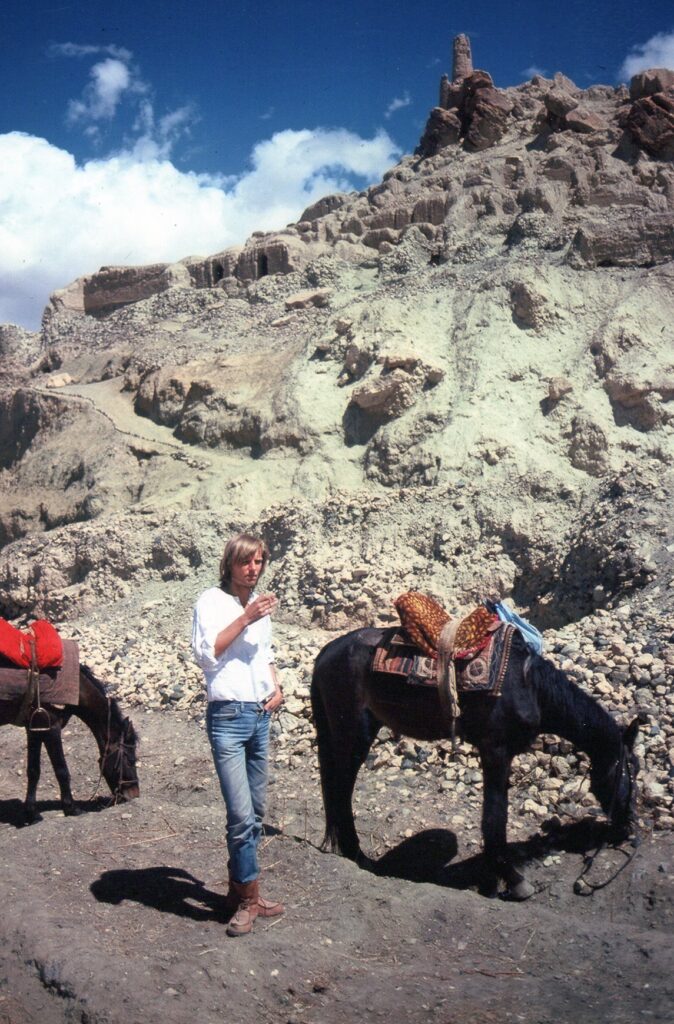
Early the next morning, we find a couple of horses to hire. We intend to cross the valley to the south and climb the mountainside there, to gain an overview of the northern cliff face and the Buddhas.
Our guide is a little twelve-year-old boy who casually throws a blanket over his horse’s back and gallops away. There is nothing to do but follow as best we can.
Along narrow paths across newly ploughed fields and up the side of the valley, we ride until we reach the now completely ruined former capital, Shar-e-Gholghola, the City of Screams. It is a steep, anthill-like hill where the city once stood.
Genghis Khan’s armies, sweeping through here in the early thirteenth century, entered Bamyan through the eastern mouth of the valley, along the same route by which we had arrived. The passage was protected by two impregnable forts until the conqueror proved otherwise by razing them to the ground.
Having gained access to the valley, they continued their ravages by capturing Shar-e-Gholghola, during which Genghis Khan’s grandson was killed by the defenders. Enraged by the loss of his grandson, he had the entire city destroyed, after which the ruler of the world ordered every man, woman and child in the valley to be beheaded. As a small additional touch, the severed heads were piled into enormous pyramids. The city took its name from the screams said to have been heard from there.
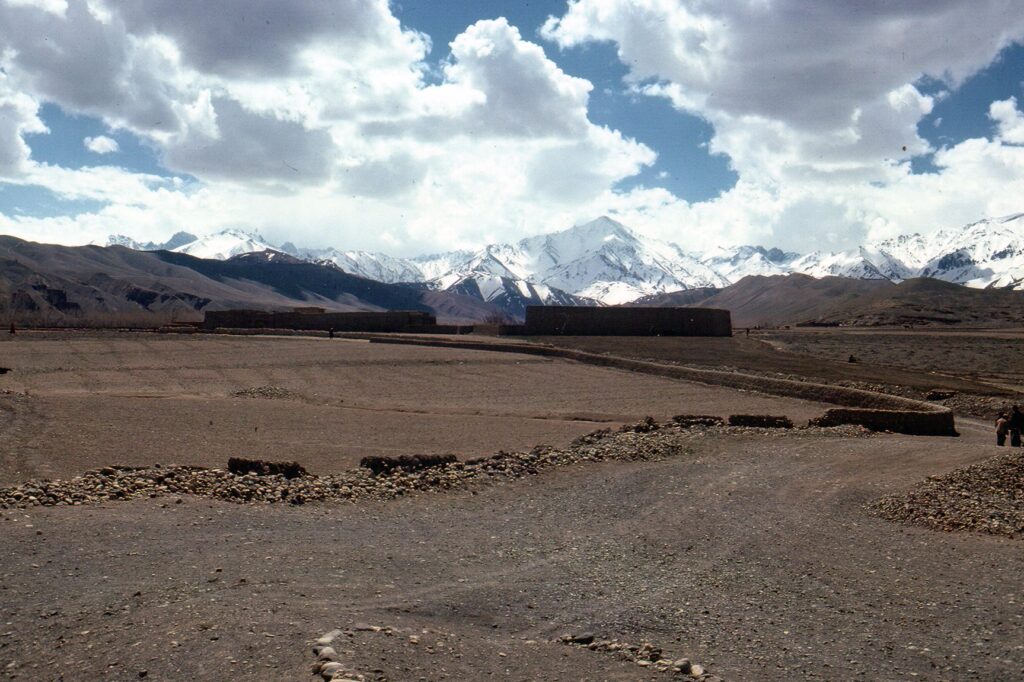
The tender spring greenery through which we travelled on the road from Kabul has not yet reached Bamyan, but in the fields, the men are busy preparing for the spring sowing. With powerful draught oxen and wooden ploughs, they cut furrows into the rich soil. The small villages we ride past are surrounded by high walls, built in a square, fortress-like style with watchtowers at the corners, even today. Yet with women and children in brightly coloured clothes on the rooftops and ox carts rolling in and out through the open gates, they make a rather peaceful impression.
We ride back towards the village and, from a plateau, look out across the valley towards the northern cliff face, where the monks’ cells perforate the rock like termite holes, flanked by the two immense Buddhas.
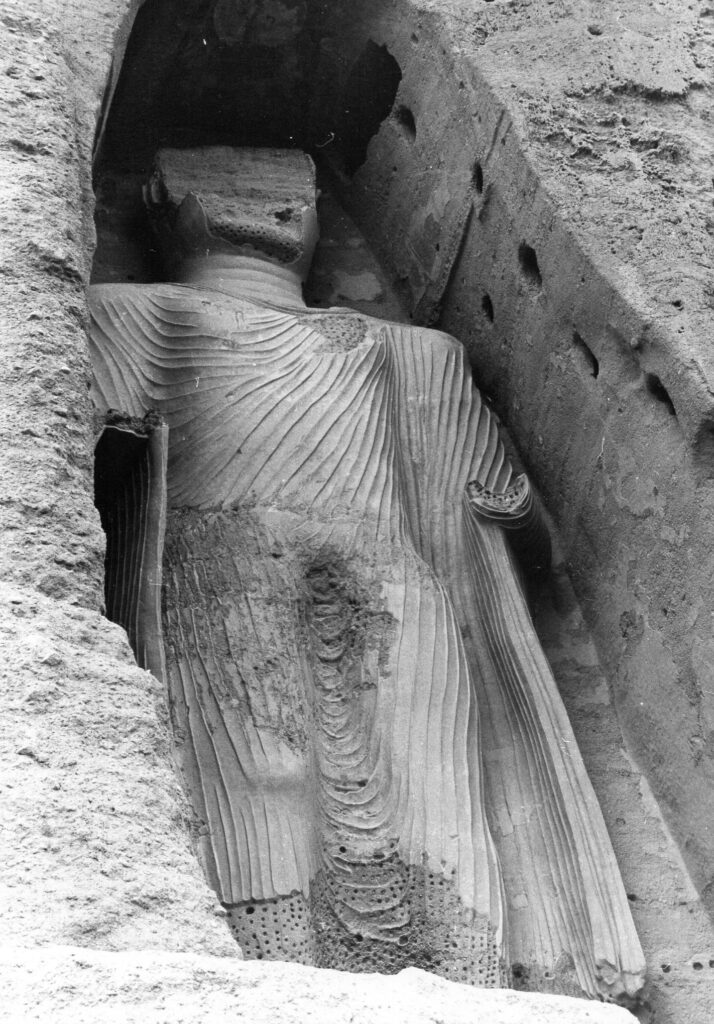
Back at the hotel, and after tending to our saddle sores, we walk up to the cliff beside the larger figure and continue eastwards through the countless hand-hewn caves towards the smaller of the two Buddhas, the forty-metre-high image carved a couple of centuries earlier, around AD 200.
Here we make our way up inside the cliff along a staircase cut into the rock, until we reach the Buddha’s head. Above the crown, we balance across to the other side of the niche along a narrow ledge. From up here, there is a magnificent view across the valley: the little village street below with its small square mud houses, the fertile valley soon to turn green, blue mountains and snow-covered peaks in the distance.
We descend through the mountain by another winding cave staircase and once again stand at the Buddha’s gigantic feet.
When the monks carved the figures more than fifteen hundred years ago, they first hewed them fairly roughly from the porous sandstone. They then drilled a series of holes and drove wooden pegs into them. Long hemp ropes were attached to these in sweeping lines along the body. A mixture of clay and straw was plastered onto the ropes, and in this way, the entire system of folds in the robes was modelled. The face, too, received its final form in clay. The surface was smoothed with stucco and the entire figure whitewashed to provide an even base for painting and gilding.
A Chinese pilgrim, Hsuan-Tsang, who visited Bamyan in the seventh century, mistakenly described the relief as being made of metal, probably because at the time of his visit it was covered with gold leaf and metal ornaments. Traces of colour can still be distinguished on one cheek and on parts of the robes, whose flowing lines have their origins in Hellenistic culture.
The walls of the niche itself once carried paintings from the life of the Buddha, of which only a few remnants remain. Erosion has taken a heavy toll on the porous sandstone, and some of the destruction, as already mentioned, occurred during the Mongol invasion.
The influence of the colossal reliefs of Bamyan on Buddhist art throughout the Far East is immeasurable. Examples of this influence can be found among the rock figures of Yun Kang and Lung Men in China, and in a gigantic bronze version in Japan.
We are roused from our art-historical reflections by a young man who politely asks whether he may invite us to dinner at his home. Delighted, we accept. We have not yet seen the inside of a real Afghan home.
At six o’clock, as agreed, we meet at the post and telegraph office, a small mud house much like the others, except for a few miserable wires emerging through the wall and an antique telephone switchboard inside. Our new friend’s brother is the postmaster and proudly explains that from here one can speak to both New York and Paris.
“And Copenhagen,” he adds when we tell him we are from Sweden.
We wait a few minutes for the father to appear. He turns out to be a distinguished gentleman in his fifties who does not speak a word of English. He wears a well-fitting three-piece suit and carries a powerful double-barrelled shotgun under his arm.
We pile into a small Land Rover, and Kersti ends up with both the double-barrelled shotgun and another gun across her lap. Our darkest suspicions seem to be confirmed: in this wild country, people carry guns to defend themselves against bloodthirsty robbers, and now they are expecting an ambush.
We point at the guns and ask in rather weak voices:
“You expect a holdup? Robbers… Pow… Pow…?”
Everyone bursts out laughing at our fears. Choking with laughter, our young friend explains that they shoot birds, not people!
Somewhat sheepish, but relieved, we put the guns aside.
Up on the plateau where we had ridden earlier that day, the Land Rover stops outside the family’s house, a large, fortress-like structure overlooking the valley. The youngest boys in the family, six and seven years old, come running out through the gate to welcome us.
They lead us inside and take us to the family living room. A large Afghan carpet covers the entire floor. A suite of imitation-leather furniture stands against the far wall, and decorating the unpainted brown walls are colourful tourist posters of the country’s sights: the blue lakes of Band-e Amir, the historic Khyber Pass and the famous mosque at Mazar-i-Sharif.
As darkness falls, a large Primus lamp is brought out. “Made in Sweden.” Its powerful light fills the room.
After dinner, which consists of rice with mutton, tea is served with sweets instead of sugar.
No women have appeared, but we are not surprised. We are in a Muslim country, and women are expected not to show themselves before strange men, even in a family as influenced by the West as this one. Almost all women in Afghanistan, apart from the new generation in Kabul and nomadic women, wear chadris, a large piece of cloth covering them from head to toe, with a small, finely meshed opening for the eyes through which they observe the outside world.
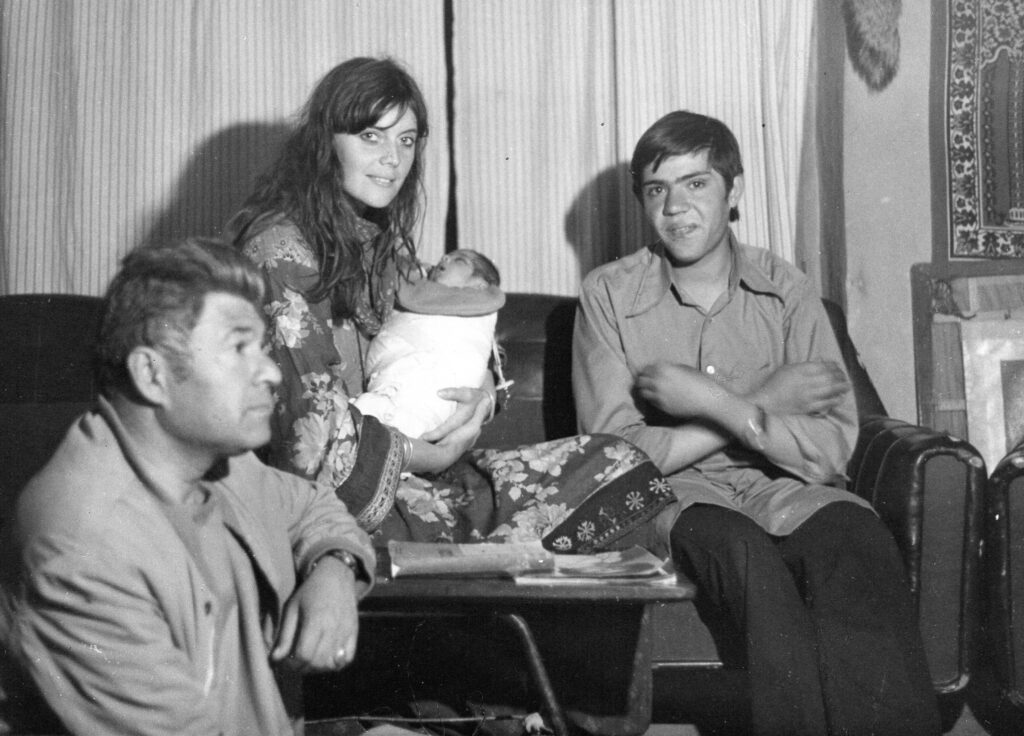
They are therefore very shy and difficult to approach, so it comes as a delightful surprise when our friend asks Kersti to accompany him into the women’s room.
The room is dominated by an enormous bed in which the lady of the house lies tucked beneath a vast layer of blankets and quilts. Beside her, two little girls of three or four are playing. They have been forewarned of Kersti’s arrival, and everyone giggles with delight and wants to touch her.
Beside the bed stands a cradle, and next to it sits a little old woman whose wrinkled face breaks into a broad, toothless grin when the baby is admired.
Kersti asks whether I, too, might come in and see the little baby, but they only shake their heads, giggle and say no. They do not want me to see them.
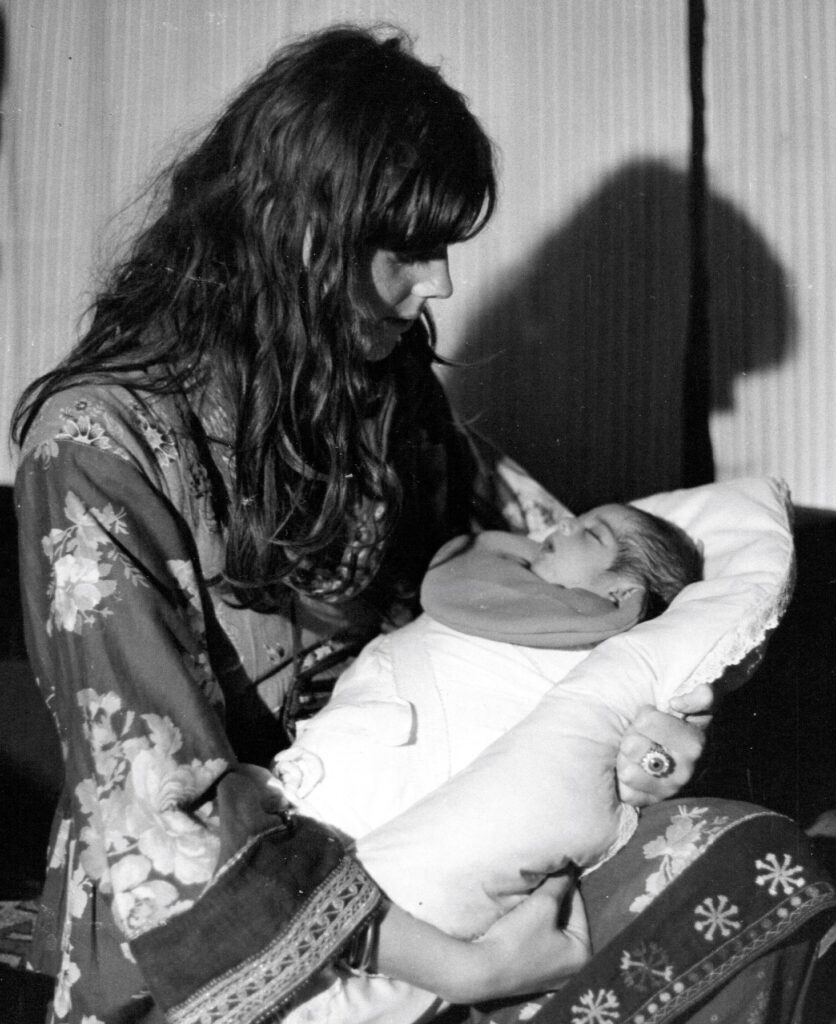
The mother in the bed whispers a few words to the old grandmother, who lifts the small white bundle from the cradle and, with a broad smile, hands it to Kersti. Slightly alarmed but proud, Kersti receives the tiny swaddled child.
It is a two-week-old girl, tightly wrapped in white cotton bands so that only her head protrudes. The mother points towards our room, and Kersti comes in to us carrying the little mummy in her arms. The father smiles proudly and points at the camera, and so, in the white light of the Primus lamp, we preserve the moment.
When at last we say goodbye to the family and step outside, we are met by a brilliant sky filled with stars and the high, clear air.
In the distance, we can make out the Buddha statues in their shadow-filled niches, as though brought back to life by the night and the starlight.
Peacefully watching over the sleeping valley.